
The Real Meaning of Wattage: Cooking Speed, Power Levels, and What to Expect

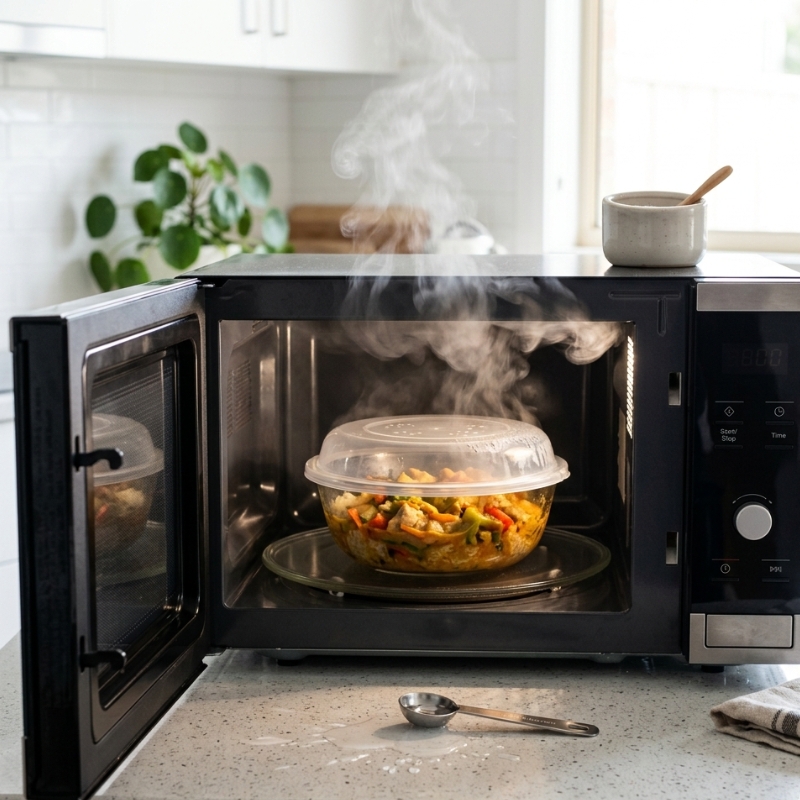
If you’ve ever followed a packet or recipe that says “cook for 3 minutes” in the microwave and ended up with a scalding edge and a cold centre, you’ve already met the two big variables that decide your results: wattage and power level.
Wattage is the headline number that tells you how much microwave energy your appliance can deliver at full tilt. Power levels are how the appliance controls that energy moment to moment. Put together, they determine not just speed, but texture, evenness, and how forgiving (or fussy) your reheating is.
This guide breaks down what wattage actually means in real kitchens, why “Power Level 5” often beats “High”, and how to adjust any cooking time with a simple formula you can use without a calculator.
Wattage in plain English
Wattage is a measure of power: how much energy the appliance can output when set to full power (usually “High” or 100%). In practice:
• Higher wattage usually cooks faster
• Lower wattage usually needs longer cooking times
• The difference is most noticeable with larger portions, dense foods, and anything frozen
Typical household models in Australia often sit somewhere around 700W to 1200W. A 1200W unit can feel dramatically quicker than a 700W unit, but that extra speed doesn’t automatically mean “better” for every food. Some foods actually come out nicer when cooked more gently.
Quick answer: Does higher wattage always cook better?
Not always. Higher wattage gives you more power on tap, which is great for speed and for heating larger serves. But for delicate foods (eggs, custards, chocolate, creamy sauces), blasting on full power can overheat the outside before the inside catches up. In those cases, using a lower power level (or shorter bursts) often improves texture and reduces mess.
Wattage vs power level: they’re not the same thing
This is the most common point of confusion:
• Wattage is your appliance’s maximum output on “High”
• Power level is a setting that reduces average output during the cooking time
On many conventional models, lower power levels don’t “weaken” the microwaves in a smooth way. Instead, they cycle the magnetron (the part that generates microwave energy) on and off.
So “Power Level 5” is often something like:
• 50% of the time ON, 50% of the time OFF (average power roughly half of full)
That cycling gives heat time to move from hotter areas to cooler areas between bursts, which is why medium power can cook more evenly.
A quick way to think about power levels
• High / 100%: maximum energy the whole time
• Medium / 50–70%: bursts of energy with “rest” time between
• Low / 10–30%: gentle bursts for softening, melting, and keeping warm
Q&A: Why does medium power sometimes feel faster overall?
Because you don’t have to redo it.
If “High” overheats the edges while leaving the middle cold, you end up stopping, stirring, scraping, and starting again. A slightly lower power level can heat more evenly the first time, which can actually get food table-ready sooner (and with better texture).
The wattage conversion formula you’ll use forever
Most recipes and packet instructions quietly assume a “standard” wattage, often around 1000W. If your appliance is different, adjust time using this simple rule:
Adjusted time = stated time × (assumed watts ÷ your watts)
If you don’t know what wattage the instruction assumes, 1000W is a reasonable starting point for many modern products. If the packaging states “based on 1000W”, use that exact number.
Worked examples (common Aussie scenarios)
Example 1: Packet says 4:00 minutes (assumes 1000W). Your appliance is 800W.
• 4:00 × (1000 ÷ 800) = 4:00 × 1.25 = 5:00 minutes
Example 2: Recipe says 6:00 minutes (assumes 900W). Your appliance is 1100W.
• 6:00 × (900 ÷ 1100) = 6:00 × 0.82 ≈ 4:55 minutes
Example 3: You have a compact 700W unit and instructions assume 1000W.
• Multiply time by about 1.43
• So 3:30 becomes about 5:00
A cheat-sheet you can remember
If instructions assume 1000W:
• 700W: add about 40–45% more time
• 800W: add 25% more time
• 900W: add about 10–12% more time
• 1100W: reduce time by about 10%
• 1200W: reduce time by about 15–20%
These are starting points. Food shape, container, and temperature still matter (we’ll cover that next).
Q&A: Do I adjust time or power level?
Adjust time first, then use power level for quality.
If the food is simple (a mug of water, a bowl of soup), adjusting time is usually enough. If it’s something that tends to split, bubble over, or heat unevenly (creamy pasta, curry, custard, rice), using a lower power level often gives better results even if the total time is similar.
Why your leftovers heat unevenly (even at the “right” wattage)
Microwaves don’t heat food the same way a pan or oven does. They excite water molecules (and some fats/sugars), which warms the food from the inside out-ish. But it’s not uniform.
Uneven heating usually comes from a mix of:
• Thickness: the centre of dense food takes longer
• Shape: tall piles heat differently to flat layers
• Water content: wetter foods warm faster than dry areas
• Container: thick ceramic behaves differently to thin glass or plastic
• Standing time: heat continues to move after the timer stops
• Cold spots from the fridge: especially in the middle of a big serve
The “doughnut effect”
Some foods heat around the edges first, leaving a cooler centre (think: lasagne, shepherd’s pie, rice bowls). That’s why ring-shaped plating helps. If you spread food around the outside of a dish and leave a little space in the middle, you increase edge area and reduce the “cold core”.
Try this:
• Make a shallow layer, or shape food into a ring
• Cover (loosely) to trap steam
• Cook at medium power
• Stir/turn halfway
• Stand for 1–2 minutes before eating
Q&A: What is “standing time” and why does it matter?
Standing time is the pause after cooking where you leave the food alone for a minute or two. During this time:
• heat spreads from hotter zones to cooler zones
• steam continues to cook the surface
• the centre warms up without more blasting
Standing time is one of the easiest ways to fix cold centres without overcooking edges.
What each power level is actually good for
Different brands label power levels differently, but the behaviour is similar. Use this as a practical guide.
High (80–100%)
Best for:
• heating liquids quickly (water, broth)
• cooking some veg fast (when cut evenly and covered)
• last “boost” at the end of a reheat
Watch out for:
• boil-overs (soups, porridge)
• exploding sauce bubbles (tomato, curry)
• rubbery edges on proteins
Medium-high (70–80%)
Best for:
• reheating single-serve leftovers that you can stir
• cooking frozen meals where you’ll stir halfway
• warming bread rolls under a damp paper towel
Medium (50–60%)
Best for:
• creamy sauces and pasta bakes
• rice dishes (especially thick, dense bowls)
• reheating meat without toughening it as much
• custards and eggy foods (with stirring)
Low (10–30%)
Best for:
• softening butter
• melting chocolate (slow and steady)
• thawing bread
• loosening honey
• gently warming baby bottles (with caution and thorough mixing)
Q&A: Why does Power Level 5 cook custard better?
Because it reduces “surface overheating”.
Custard, eggs, and dairy thicken when proteins heat. On full power, the outer parts can overheat and curdle before the inside warms. Medium power gives the heat time to spread, so you get a smoother result with less risk of scrambling.
How to find your appliance’s wattage (quickly)
You can usually find wattage in one of three places:
• the rating label inside the door frame or on the back panel
• the user manual/spec sheet
• the model listing on the manufacturer’s site
Look for “Output power” or “Microwave output”. Don’t confuse it with input power (which is usually higher). Output is the number that matters for cooking time.
If you’re upgrading or comparing, it can help to browse our range of microwaves and check the listed output power so you can match your cooking habits to the right level of speed.
A practical “power level playbook” for everyday foods
Instead of guessing, use a repeatable approach.
Leftover rice, pasta, and dense meals
Why it’s tricky: dense, thick, and often dry in spots.
Do this:
• Add a splash of water (1–2 teaspoons per serve)
• Cover loosely (lid ajar or vented cover)
• Medium power (50–60%)
• Stir halfway
• Stand 1–2 minutes
Soup, curry, and saucy leftovers
Why it’s tricky: bubbles and boil-overs.
Do this:
• Use a larger bowl than you think
• Medium-high (70–80%) in 60–90 second bursts
• Stir between bursts
• Finish with a short high-power boost if needed
Frozen vegetables
Why it’s tricky: icy sections and uneven pieces.
Do this:
• Add a tablespoon of water
• Cover
• High power is fine if the layer is even
• Stir/turn once midway
• Stand briefly
Chocolate, butter, and gentle melting
Why it’s tricky: chocolate holds shape while melting, then suddenly scorches.
Do this:
• Low power (10–30%)
• Short bursts (15–30 seconds)
• Stir even if it looks unchanged
Q&A: Why does chocolate burn even when it looks solid?
Chocolate can melt internally before it looks melted on the outside. If you keep heating because it “doesn’t look melted yet”, you overshoot and scorch it. Low power and stirring prevent that.
Inverter models: why they feel different
Some appliances use inverter technology, which can deliver a steadier level of power at “medium”, rather than cycling fully on/off. The result can be:
• more consistent low-to-medium cooking
• gentler defrosting
• fewer “hot edge / cold centre” moments for some foods
You don’t need an inverter model to get good results, but it explains why “Power Level 5” behaves differently across appliances.
If you’re comparing features, it can help to understand which types of microwaves are most energy-efficient, as well as wattage, cavity size, and whether you prefer quick high-power reheats or slower, gentler cooking.
The three things that matter as much as wattage
Even with perfect wattage maths, these practical factors can make or break results.
1) Container shape and material
• Wide, shallow dishes heat more evenly than tall mugs or deep bowls
• Glass and ceramic hold heat; thin containers heat faster but can be less even
• If the centre stays cold, switch to a wider dish and spread food out
2) Covering (with a vent)
Covering traps steam, which helps surface heating and reduces splatter. But you still need a vent so pressure doesn’t build.
Easy options:
• a microwave cover with vents
• a plate set slightly off-centre
• cling wrap with a small corner lifted (use products labelled microwave-safe)
3) Stirring, rotating, and standing
These are the “evenness tools” that beat brute force:
• Stir liquids and saucy foods at least once
• Rotate plates or turn containers if there’s no turntable
• Let food stand so the centre catches up
Food safety: don’t let wattage maths create cold spots
Uneven heating isn’t just a texture issue. It can be a food safety issue when reheating leftovers, especially thick dishes and mixed meals.
A simple rule of thumb: reheat leftovers until they’re steaming hot throughout, and take extra care with dense foods (like rice dishes, pasta bakes, and meat-based meals) where the centre can stay cooler.
For Australia-specific guidance on safe cooling and reheating practices, see Food Standards Australia New Zealand’s advice on cooling and reheating food safely.
Q&A: If my food is hot on the outside but cool in the middle, what should I do?
• Stir or rearrange the food to expose the cooler parts
• Switch to a wider, shallower container if possible
• Use medium power and add a bit of time
• Stand for a minute, then check again
If it’s a thick, dense portion (like a big slab of lasagne), cut it into smaller pieces and reheat in stages.
Troubleshooting: common wattage and power-level “mysteries”
“My appliance says 1000W but it still feels slow”
Possible reasons:
• you’re looking at input power, not output power
• the food is very cold or very dense
• the container is deep and narrow
• you’re cooking multiple items at once
• the door seal is dirty or the turntable isn’t rotating properly
Try:
• spreading food into a shallow layer
• cooking one serve at a time
• using a medium power level for better penetration, then finishing briefly on high
“Power Level 10 and 100% seem identical”
They usually are. Many models label 10 as 100%.
“Defrost works, but cooking after defrost is uneven”
That’s normal. Defrosting can create warm edges with a still-frozen centre. After defrost:
• rest the food for a few minutes
• separate pieces if you can
• cook at a lower power level first, then increase
A simple routine for better results every time
When you’re not sure what to do, this “default method” works for most leftovers:
• Put food in a wide, shallow dish (ring shape if it’s dense)
• Add a splash of water if it’s starchy or dry
• Cover loosely
• Medium-high for 60–90 seconds
• Stir/rotate
• Medium for another 60–90 seconds
• Stand 1–2 minutes
• Adjust with short bursts as needed
Once you know your appliance’s wattage, you can refine the timing. If you’re ready to match your typical meals to the right wattage range, you can see microwaves available in Australia and compare output power across sizes and styles.
FAQs
What wattage is best for everyday reheating?
For many households, around 900W to 1100W feels like a sweet spot: fast enough for daily reheats, but still controllable with power levels for delicate foods. Smaller kitchens and light use can be perfectly happy with 700W to 800W.
Why do packet instructions never match my results?
Packets often assume a particular wattage (commonly around 1000W) and a “typical” portion shape. Your appliance wattage, dish shape, starting temperature, and how often you stir can all shift the outcome.
Is it better to use lower power for longer?
Often, yes — especially for dense leftovers, dairy-based sauces, and eggy foods. Lower power gives heat time to spread and reduces overcooked edges. It can be slower on paper but quicker in practice if it avoids hot/cold problems.
What does “Power Level 5” mean?
On many models, it means the appliance cycles on and off so the average power is about half of full. On inverter models, it may deliver a steadier reduced output instead of cycling.
How do I convert a 1000W recipe for a 700W appliance?
Multiply the time by about 1.4 (or use: stated time × 1000 ÷ 700). Then watch the first attempt closely and adjust in small increments. Dense foods benefit from medium power plus standing time.
Why does my food spark sometimes?
Sparks (arcing) can happen if there’s metal (foil, some trims on containers), twist ties, or even food with high salt/fat creating hotspots near the edges. Stop immediately, check the container, and avoid anything with metallic paint or trim.
Do I need to stir if I have a turntable?
Stirring still helps. Turntables reduce hotspots, but they don’t eliminate them — especially in thick or mixed foods.