
Oven Sizes Explained: How to Choose Capacity for Your Household

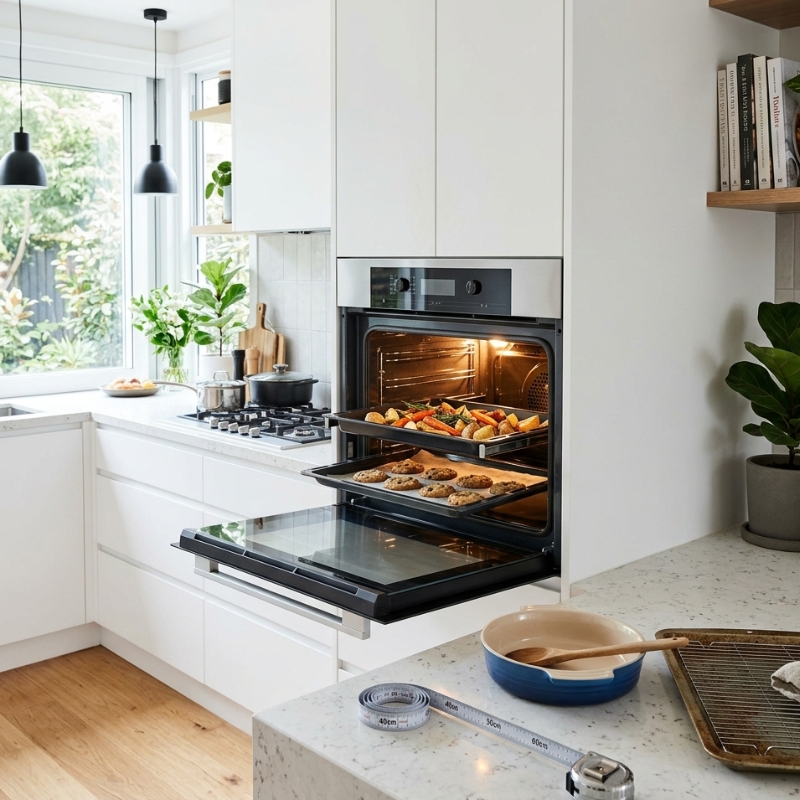
Buying an oven sounds simple until you’re stuck choosing between a 60cm and a 90cm model as part of your wider kitchen appliances decision, comparing “capacity (L)” numbers that don’t feel real, and wondering whether your Sunday roast tray will actually fit.
This guide is written for Australian kitchens and real-life cooking. You’ll learn how oven size and capacity work, which measurements matter most, and how to match your oven choice to your household without overbuying (or regretting a too-small cavity).
Start with the two “sizes” that matter: width and usable space
Most people shop by width first because it’s the easiest thing to picture.
• 60cm ovens are the most common built-in width in Australia, and suit most everyday cooking
• 75cm ovens exist but are less common (often a “middle ground”)
• 90cm ovens are popular for entertainers and larger households, mainly because you get a wider cavity and larger trays
But width is only half the story. The second half is what you can actually cook at once: usable internal space.
Width is not the same as capacity
Two ovens can both be “60cm” wide but feel very different inside. That’s because internal design changes the usable space:
• thicker insulation (common in pyrolytic models) can reduce internal width
• fans, side-racks, and shelf supports can change how wide a tray sits
• the shape of the cavity affects whether you can fit bulky dishes side-by-side
That’s why it’s smart to treat “60cm” and “90cm” as a starting filter, then choose based on how you cook.
What oven capacity (litres) actually tells you
Capacity is usually shown in litres (L). In theory, more litres means more room for food. In practice, litres are most helpful when you use them as a rough band, not an exact measure.
As a general Australian guide:
• smaller ovens are often around 30–45L
• mid-size ovens commonly sit around 45–70L
• larger ovens are often 70L+ (with some 90cm models going well beyond that)
Those ranges line up with how major brands and retailers describe common oven sizes in Australia.
Why litres can be confusing
Capacity numbers can be measured in different ways (and sometimes brands quote a “gross” figure that feels bigger than the usable reality). So instead of chasing the biggest number, use litres to narrow your shortlist, then check practical fit:
• does your largest roasting pan sit flat on a shelf?
• can you bake two trays without one blocking airflow?
• can you fit a tall dish (like lasagne) without scraping the top element?
A practical “match your household” guide to oven capacity
Below are typical matches that work well for many Australian homes. Your cooking style matters as much as headcount, so think about your busiest cooking moments (not your quietest ones).
Singles and couples (everyday meals, occasional hosting)
You’ll usually be fine with:
• a standard 60cm oven
• a mid-range capacity (often around 45–70L)
This is enough for weeknight trays, a roast chicken, and basic baking. If you rarely cook multiple dishes at once, going bigger can just mean more space to heat up.
Small families (3–4 people)
A common sweet spot:
• 60cm oven, but prioritise a better internal layout
• enough shelf positions to run two trays comfortably
If you batch cook, bake, or do “main + sides” together, pay attention to cavity shape and tray width more than the litre number.
Larger families (5+ people) or frequent entertainers
This is where bigger sizes earn their keep:
• consider 90cm if you regularly cook multiple trays, larger roasts, or need extra width
• alternatively, consider a double oven setup if your kitchen layout supports it
Retailer buying guides often call out 90cm and double ovens as a better match for larger households and entertaining.
60cm vs 90cm ovens: the real-life differences
Let’s translate this into kitchen reality.
Cooking capacity and tray flexibility
A wider cavity can allow:
• larger trays (useful for cookies, roast veg, or multiple pizzas)
• two dishes side-by-side more comfortably
• easier multi-tray baking without crowding
That said, a well-designed 60cm oven can outperform a “bigger” oven with awkward internal geometry.
Installation and space planning
A 60cm built-in oven generally fits standard cabinetry setups. A 90cm oven may require:
• wider cabinetry (and sometimes changes to adjacent drawers/cabinets)
• more thought about bench clearances and door swing
• careful checking of cut-out specs
Running costs and efficiency
Bigger cavities can take more energy to heat and keep hot, especially if you’re often cooking small meals.
When you’re comparing models, it’s worth checking the appliance’s energy information. Australia’s government-backed program explains how the label helps you compare energy use within an appliance category. You can read the overview of the Energy Rating label.
(That’s not saying “always buy smaller” — it’s saying “buy the right size for how you actually cook”.)
The measurements Australians forget to check (and how to avoid a fit-up)
Oven sizing mistakes usually happen because people measure one thing and assume the rest.
Measure 1: cabinet cut-out (not just the old oven’s front)
Your old oven’s visible front doesn’t tell you what the cavity behind it looks like.
Do this instead:
• find the installation manual for the new model and note the required cut-out dimensions
• measure the cabinet cut-out width, height, and depth
• check if the oven needs ventilation gaps around the sides/back
Measure 2: depth and “handle projection”
Some ovens stick out further once installed, especially with chunky doors/handles. That can affect:
• walkway clearance in galley kitchens
• whether drawers can open past the handle
• whether your oven sits proud of cabinetry in a way you dislike
Measure 3: door swing and nearby obstacles
If your oven is near an island, pantry door, or a corner wall, door swing can become annoying fast. A deeper or wider oven can amplify the problem.
Measure 4: electrical connection requirements
Many ovens are hardwired (and some are plug-in). If you’re changing oven type, size, or features (like moving to pyrolytic), you may need electrical work done correctly and safely.
If you’re unsure, treat it as a “licensed pro” moment rather than a DIY experiment.
Don’t shop by litres alone: use these “cook tests”
If you want to choose confidently without getting lost in specs, use these quick tests while you’re researching models.
The roast + sides test
Ask yourself:
• can you fit your largest roasting dish plus a tray of veg at the same time?
• can you do it without stacking too tight or blocking the fan?
The two-tray bake test
If you bake:
• can you run two trays with decent space between shelves?
• does the oven support even heat across multiple shelves (fan-forced helps, but design matters too)?
The “bulky dish” test
Think about:
• tall dishes (lasagne, covered casserole, sourdough)
• whether the top shelf position leaves enough headroom
• whether the grill element position reduces practical height
Choosing a refurbished oven size without compromising on fit
Buying refurbished can be a smart way to get a better feature set within budget, but the sizing rules get even more important. Refurbished stock can include a wider mix of models (including older lines) where dimensions and design quirks vary.
If you’re choosing a refurbished appliances for your household, focus on these steps:
• match the width to your cabinetry first (60cm vs 90cm)
• confirm cut-out requirements from the specific model documentation
• prioritise internal layout (shelf supports, tray width, usable shelf positions) over headline litres
• check how the door seals and hinges feel (important for heat retention and safety)
• confirm what accessories are included (shelves, trays, rails), because replacements can be surprisingly specific
Refurbished doesn’t have to mean “guesswork” — you just need to be a bit more methodical about fit and inclusions.
Q: Is a refurbished 90cm oven worth it for a family?
If your cooking routine includes multi-tray meals, bigger roasts, or entertaining, the extra width can genuinely make weeknights easier. If most meals are one tray or a single dish, you may be better off with a well-laid-out 60cm oven and investing in features that improve results (even heat, temperature control, cleaning mode).
Features that affect usable space (even when the size is the same)
Two ovens of identical external width can feel different inside because of features.
Pyrolytic cleaning
Pyrolytic ovens often have heavier insulation and door construction for high-temp cleaning cycles. That can slightly reduce internal cavity space compared with a similar non-pyrolytic oven.
Air fry modes and extra accessories
Some models include air fry trays, extra shelf supports, or rails. Great features — but they can also change how you use the cavity.
Side racks vs telescopic rails
Telescopic rails are brilliant for heavy dishes, but they take space. If you’re tight on internal width, rails can influence what trays fit comfortably.
Decision shortcuts for common Australian kitchen scenarios
Here are quick “if this, then that” shortcuts that tend to hold true.
If your kitchen is a standard built-in layout
• default to 60cm unless you have a strong reason to go bigger
• invest time in checking internal tray fit and shelf layout
If you cook for a crowd more than once a month
• consider 90cm or a double-oven approach
• look for a cavity that supports true multi-dish cooking, not just a big litre number
If you’re renovating and changing cabinetry anyway
This is your chance to future-proof:
• decide whether you want 60cm forever (most flexible for replacements)
• if you want 90cm, make sure the design leaves breathing room for adjacent drawers and door swing
If you want a better oven without blowing the budget
Refurbished or outlet options can be a practical path — just be strict about measurements and model-specific cut-outs, because the wrong fit can wipe out any savings.
If you want to keep researching across your whole kitchen plan (not just ovens), you can browse kitchen appliance options and use the oven decision as part of a wider “what fits my space” plan.
Q&A: the questions Australians ask most about oven sizes
Q: What size oven does a family of 4 need?
For many families of four, a 60cm oven with a practical internal layout is enough. If you regularly cook multiple dishes at once (main + sides, multi-tray bakes, entertaining), a larger capacity or wider cavity can reduce the “cooking Tetris” stress.
Q: Is a 60cm oven big enough?
Often, yes. A 60cm oven is the most common built-in size in Australia and is widely considered suitable for most cooking tasks, with larger widths catering more to bigger households and entertaining.
Q: Can I replace a 60cm oven with a 90cm oven?
Not without cabinetry changes. A 90cm oven generally needs a wider cut-out and may affect adjacent drawers/cupboards. If you’re thinking about the jump, confirm the new model’s installation requirements before you commit.
Q: Do oven litres matter?
They matter as a rough guide, but they don’t tell the whole story. Usable cooking space depends on cavity shape, shelf layout, and tray width. Use litres to narrow your shortlist, then check whether your real cookware fits.
How to choose confidently in 15 minutes
If you want a simple process, do this:
- Decide your width (60cm vs 90cm) based on cabinetry and how you cook
- Choose a capacity band that matches your household needs
- Check the cut-out requirements for the exact model
- Validate with the “cook tests” (roast + sides, two-tray bake, bulky dish)
- Consider features that may reduce usable space (pyrolytic insulation, rails)
If you’re planning a broader update and want a single place to keep your research organised, a kitchen appliance buying guide approach can help you make sure everything works together (space, power, cooking habits, and budget).
FAQ: oven sizing and capacity in Australia
What are the most common oven widths in Australia?
Built-in ovens are commonly 60cm wide, with 75cm and 90cm also available (often chosen for larger households or entertaining).
How many litres is a “standard” oven?
Many standard-sized ovens fall into broad bands rather than one exact number. As a rule of thumb, common mid-sized ovens often sit around 45–70L, with larger ovens commonly 70L+.
Is a double oven better than a bigger single oven?
It depends on how you cook. Double ovens can be excellent if you regularly need different temperatures at the same time, or if you want a smaller cavity for quick meals. A larger single oven can be better if you often cook big trays, large roasts, or need width more than separate zones.
What should I measure before I buy a new oven?
Measure the cabinet cut-out (width/height/depth), check door swing clearance, and confirm electrical connection requirements. Don’t rely on the old oven’s external front as a proxy for the cavity.
Does pyrolytic cleaning reduce oven capacity?
Sometimes, slightly. Pyrolytic models can have thicker insulation and door construction, which may reduce usable internal dimensions even when the external width is the same.
Are refurbished ovens harder to size correctly?
They can be, simply because the range of models (and model years) is wider. The fix is straightforward: always confirm the exact model’s cut-out requirements and validate internal tray fit before committing.